
August 28th, 2026
Multi-entity, multi-currency reconciliation at month-end
Key Takeaways
- Fragmentation is the root cause, not the symptom. With 93% of companies banking across multiple institutions, most reconciliation pain traces back to normalizing incompatible file formats (BAI, MT940, CAMT, CSV, XML) before matching can even start.
- Not every mismatch is an error. Timing gaps – unpresented cheques, deposits in transit, card-processing lag – create discrepancies that look like problems but are really just float. Manual processes waste time investigating these as if they were mistakes.
- Manual reconciliation doesn’t scale – it just adds headcount. The “spreadsheet trap” means transaction growth gets matched with more people, not more insight, while also weakening audit trails and raising fraud risk.
- Automation gains are concrete, not theoretical. The case studies back this up with real numbers: Makita UK cut cash management time by 45%, and Shaklee Malaysia hit 98% automation, reconciling seven branches and 150,000 dual-role distributors in minutes instead of days.
For most finance teams, the month-end close is where problems that were invisible all month suddenly become urgent. Bank reconciliation – comparing internal records against bank statements – is the control that catches discrepancies, bank errors, and fraud before they reach the books. It’s also one of the easiest processes to let slide into manual patchwork, especially once a company operates across multiple entities, banks, and currencies.
When the close drags on, the cost isn’t just staff time. Leadership ends up making working-capital and debt decisions on numbers that are a few weeks stale, because the “true” cash position hasn’t been confirmed yet.
Why Global Reconciliation Gets Hard Fast
Reconciliation inside a single entity, single bank, single currency is a solved problem. Add more entities and banks, and it stops being a linear task – it becomes a set of disconnected data feeds that someone has to stitch together by hand. Three things drive most of the difficulty:
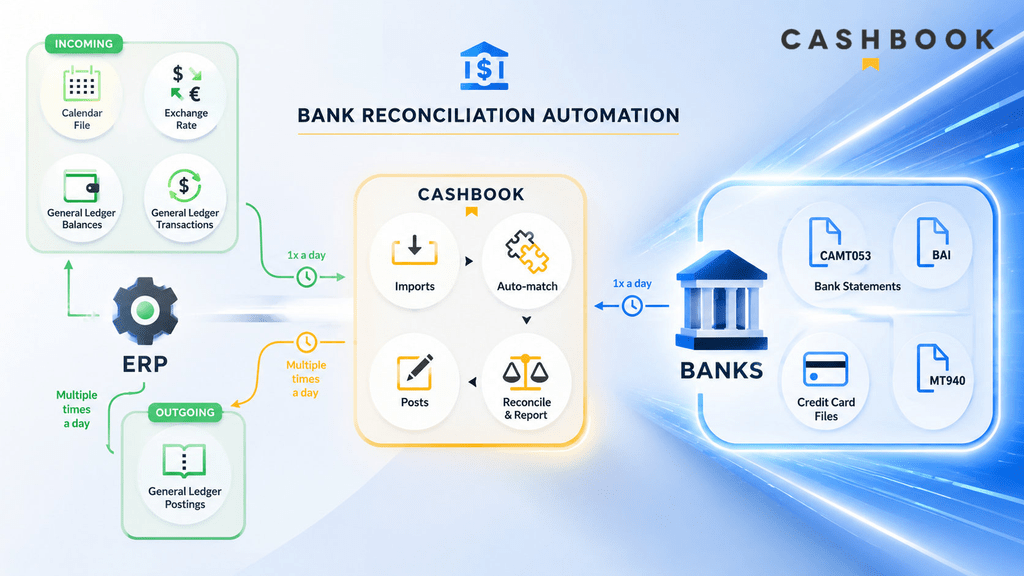
Data fragmentation. Roughly 93% of corporate entities bank with more than one institution, and each one exports data in its own format – BAI, MT940, CAMT, CSV, XML. Normalizing all of that into one usable view is where a lot of reconciliation errors originate.
Timing gaps. Unpresented cheques, deposits in transit, and card-processing delays can take weeks to show up on a bank statement even though the ERP recorded them immediately. Every one of these creates a mismatch that has nothing to do with an actual error – it’s just timing – but still has to be investigated as if it might be one.
Currency movement. Multi-jurisdiction operations need FX gains and losses booked correctly, plus netting of debits against credits across currencies. That’s a level of precision manual processes struggle to hold consistently.
The Spreadsheet Trap
As transaction volume grows, matching entries by hand doesn’t scale – it just demands more headcount. That’s the trap: adding people doesn’t add insight, it just keeps pace (barely) with volume.
| Process attribute | Manual limitation | Impact |
|---|---|---|
| Security & integrity | Spreadsheets are easy to edit or corrupt with no real controls | Higher fraud risk, ledger integrity in question |
| Error rate | One mistake propagates through every downstream report | Costly corrections, less trust in the numbers |
| Visibility | Only as current as the last manual update | Leadership sees stale cash positions |
| Resource allocation | Skilled staff spend their time on data entry and matching | Higher cost, less strategic capacity |
| Audit readiness | Audit trail is a folder of spreadsheets, not a system | Higher audit fees, slower close |
Without a centralized, timestamped record of who changed what, reconciliation becomes hard to audit and easy to manipulate – intentionally or not.
How Cashbook’s Reconciliation Module Automates the Match
Cashbook’s reconciliation module sits on top of existing ERP infrastructure – Infor, JD Edwards, Microsoft Dynamics 365 among others – rather than requiring a rebuild of the core system. That matters because ERP customization projects tend to be slow and create their own maintenance burden down the line.
The module gets to roughly 95% automation through three mechanisms:
Month-end roll-over. Any unpresented cheques or lodgements get marked as open items. They are carried into the next period automatically. The current period closes cleanly instead of waiting on items that simply haven’t cleared yet.
Matching rules that handle real-world messiness. Aliases link bank items to ledger entries even when there’s no obvious numerical relationship. The engine also matches non-standard references (a statement showing “000123” against a ledger entry of “123”) and handles many-to-one cases, like one bank deposit that represents dozens of separate ledger lines.
Automated FX, netting, and adjustments. Journals for bank fees, interest, and service charges are generated automatically. Debit/credit netting across currencies and tolerance-based write-offs for small variances happen without someone manually clearing them line by line.
What This Looks Like in Practice
Makita UK connected its ERP directly to banking data and cut time spent on cash management by 45%. That freed the finance team to spend more time on liquidity analysis instead of matching transactions.
Shaklee Malaysia had a harder problem: 150,000 distributors who act as both customers and vendors, reconciled through an interface between their Yatai system and Infor LX. After automating that, they reached a 98% automation rate – what used to be a branch-by-branch manual process across seven branches now reconciles in minutes from one central hub.
The reconciliation module also keeps a full audit trail – every action timestamped, with more than eight report types covering things like auto-write-offs and outstanding transactions – so the organization isn’t scrambling to reconstruct a paper trail when auditors ask for one.
What can finance teams learn from MTD Products?
MTD Products provides a useful example of the problem at scale.
Its deductions team manually processed up to 10,000 deductions each day. Eight full-time employees supported the process, including significant investigation of deductions with unknown reasons.
MTD implemented Cashbook’s Deductions module. The solution automated the upload of customer remittances and supported reason-code assignment and deduction creation.
The reported results were significant. MTD automated 80% of deductions and increased repaid deductions by more than 40%.
Its deductions team also reduced from eight people to six. The business could process smaller items that previously received little or no attention.
The important lesson is not simply the automation percentage. Lower processing effort changed which deductions were practical to pursue.
The Bottom Line
Bank reconciliation doesn’t have to be the part of the close that everyone dreads. Moving off spreadsheets and onto a matching engine that handles the messy cases – non-standard references, FX, many-to-one deposits – turns a multi-week scramble into a process that runs close to real time.
Cashbook has been building these systems for 25 years – for more on the reconciliation module, see Solutions and Bank Reconciliation.
Contact Cashbook today to see how we can take the pain out of your bank reconciliation process.
About Author
Dave Ewing is the Marketing Manager at Cashbook, bringing over 20 years of expertise in marketing and technology to the role. He focuses on sharing valuable insights into cash management, accounts receivable automation, bank reconciliation, and ERP-integrated financial processes. In addition to his marketing efforts, Dave plays a key role in product development, helping to create innovative solutions that empower finance teams to work more efficiently.